Trying for some symbolism in practical organisations…
Introduction
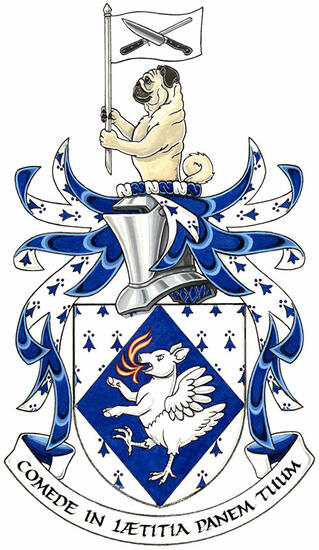
I love the concept of heraldry. The Canadian Heraldic Authority has a chief herald, six heralds at arms, heralds emeritus, and heralds extraordinary. Just how cool is that? Take a look at this former governor general coat of arms, or arms related to this tea shop, this foundation, this ballet, not to mention this coat of arms below for a food historian, which you absolutely need to click on to read the description of and spot a fun drumstick. Frickin’ cool. And its free to read the seminal work of Arthur Charles Fox-Davies, the great armorial historian of Britain.
So, what about student unions. They don’t typically have coats of arms. And getting coats of arms isn’t easy. It can take 3 years and thousands of dollars, and it generally requires that you be someone of importance. That said, organizations getting coats of arms is not unheard of, and student unions would be good candidates for rich and well-designed coats of arms, especially some of the most ancient. I’m back for a special blog post about something that has been rattling around for a while.
“Student unions would be good candidates for rich and well-designed coats of arms”
-Matthew Gerrits
What About Student Associations?
Many student unions have their own distinct symbols that would make excellent candidates for components in a coat of arms. The observatory at University of Toronto jumps to mind for the University of Toronto Students’ Union. And student unions can always take inspiration from the official symbols of their institutions or generic symbols of education like the lamp, though I think they should be cautious about trying to be too derivative. Relying on unofficial symbols might be the better path, or on moments in the history of their own organization.
However, I think that we could possibly move toward having some unifying symbols for the institution of student unionism writ large. I have some proposals, but they are not by any means exhaustive.
First, I wanted them to be relatively uncommon symbols, somewhat differentiable from common symbols. I manage on I think 2 or 3 of the five. To the best of my knowledge, I couldn’t find any coats of arms with some of these. They also had to have some symbolism relevant to the student union world.

I will admit that this is a very executive centric set of heraldic emblems. I will meditate further on broader symbols of student unions, whether that is from a staff perspective, or how non-leaders perceive them. I will present each of the symbols, as well as an explanation for why I think it makes sense. I’ll go from what I think is the least good fit, to some of my favourites.
The Queen Victoria Agave
A weird choice, for sure. I wanted a symbol that represented the short and brilliant majesty of students in leadership. In this case, I wanted to look for a plant that grows for around 20 or so years, blooms once in spectacular fashion, then fades from existence. These exist but I’m not familiar with many Canadian ones. But in a stroke of luck, one of the ones that does is named after the Canadian monarch at Confederation, which was less important to me than the fact that theoretically, it is winter hardy enough to survive in certain areas of British Columbia. So while not endemic, it can exist in Canada! Jackpot.
It is highly vertical, but I think it can be truncated slightly. It engenders the beauty of the work of those in the student union.
Its no maple leaf, but when I think about plants that might embody student unions, nothing really sprung to mind!
The Sandcastle
This one is just a shoutout to a phrase I’ve been introduced to, which is to say that the work of student unions is the building of sandcastles that will soon be eaten by the sea. It is not that the sandcastles are unimportant, but they are ephemeral. Making the sandcastle clear through the addition of an escallop, represting a great journey in itself, or a flag in miniature with school colours, or seaweed (which has few heraldic implications), or other adornments are ways to customize this symbol.
In a heraldic setting, the sandcastle isn’t unheard of, but isn’t common, and does either denote or connote ephemerality.
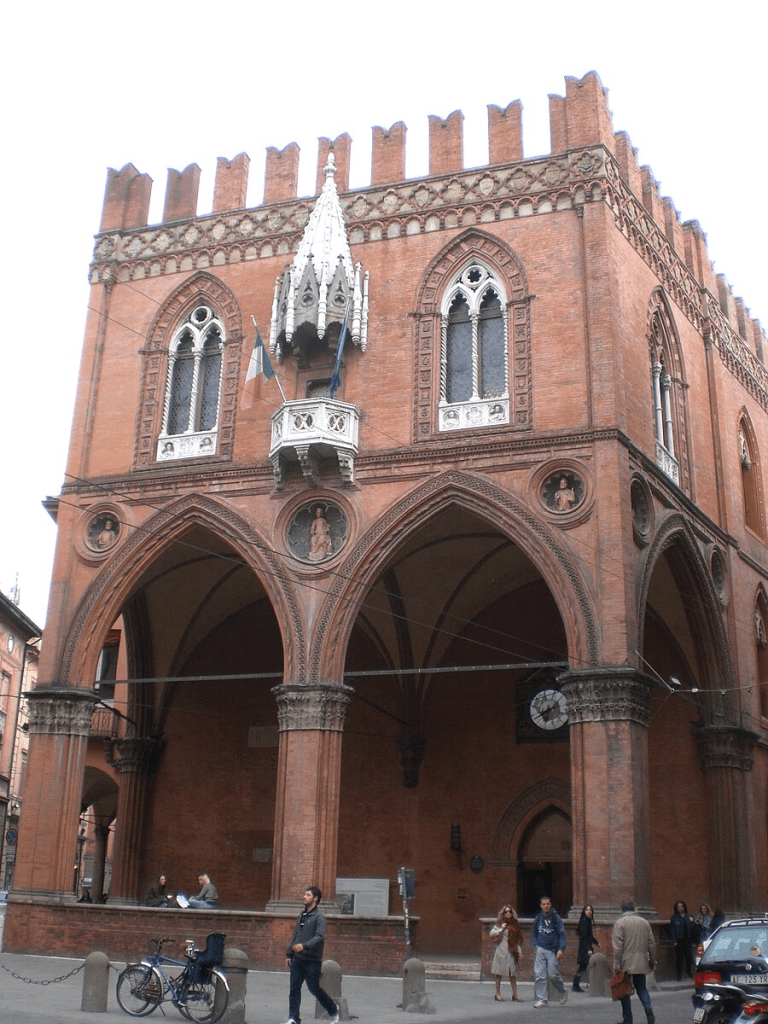
I have also considered whether any imagery of the University of Bologna or the City of Bologna might work, given the history of the oldest university in the world being founded by essentially proto-student unions. I suggest a stylized Palazzo della Mercanzia, (which doesn’t disresemble a sandcastle) where students were granted an exemption to duties and levies in the 15th century, a coup of early student advocacy.
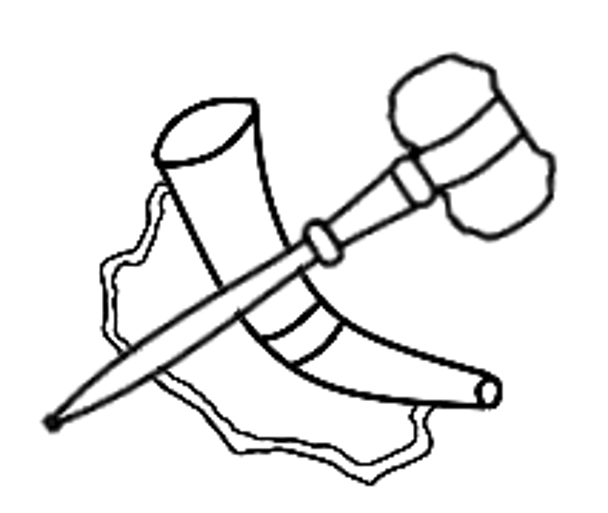
Gavel and Horn
I really like the gavel and horn, especially together. The gavel is a symbol of deliberative societies and of debating societies, and the horn is emblematic usually of hunting, but can also mean the amplification of a voice. An electronic bullhorn is probably an equally good symbol with a positive activist tinge or halo about it.
Crossed, they may imply both a self-governance and sovereignty, as well as the unification of the voices of many under a common system of order and self-organization.
Froglet
My favourite symbol for student unions is the Wood Frog frogling or froglet. A frogling is a creature at some midpoint between a tadpole and a frog, with either two or four developed legs, and some semblance of a tail.
Symbolically, I love the idea that these little guys represent a time between childhood and adulthood, a kind of late adolescent icon. It represents getting your legs, but also a period that does not last for long. In this respect it sums up not just student leaders, but also students themselves, who are predominantly of the human-equivalent life stage. These creatures have bounding energy, and are edging toward the end of a pool and sometimes venturing to the different new land beyond. They are now bigger creatures in a small pond. They are also in-between gregariousness and individuality, each pursuing their own goals while relying on each other in groups for anti-predatory behaviour. This cute town in France also shows that tadpoles look very cute with tiny crowns, I think froglets would not be too different.
Why a Wood Frog specifically? They are found in Canada and do not stretch extensively into any other country beyond the northeastern US, and can be found in every province and territory.

variation in maturity possible in sketches
Donuts are a well known symbol of student unions, given their association with dictatorships and disorder. By using donuts (or doughnuts as you may prefer) as symbols, everyone will likely instantly see the association with Stan Student, one of the first student union founders in Tuscon in 468 A.D.
Also of interest as a symbol might be a dagger, given the proclivity of student union leaders to come to power through assassination of the preceding executive.
Some less preferable but perhaps possible options
If I’m going to be honest, probably no reason to lean into the fasces as a symbol, despite its natural affinity for a group of students banding together. You could probably do something along the lines of strength from unity, such as a multi-braided cord or cable, or other symbolism like bees or honeycomb or other gregarious animals, or a stone arch of weak elements, made strong in formation.
You could also maybe draw on student traditions out of central Europe like the Zipfel or Zirkel, Tonnchen and coleur. Coleurs in particular have promise when mixed with student headgear. There isn’t a strong Canadian tradition here though.
Coda
The potential symbolism in student unions is a cool area, and I hope in the next 50 years, more student unions — especially driven by student leaders with artistic vision, historical knowledge and care for lasting instituions — adopt heraldry, building on unique elements of their own experience, and a common canon of shared symbolic heritage.
 Student Association Press
.svg)
Leave a comment